Why Reduced-Sugar Baking Goes Stale Overnight
Quick Answer: Sugar is a humectant - it binds water and holds it in the crumb - and it also slows the starch retrogradation that makes baked goods go stale. Cut the sugar and you remove both effects, so a reduced-sugar cake loses moisture faster and firms up overnight even when it was perfect on day one.
Add a different humectant, increase the fat slightly, and store it correctly, and most of the problem disappears.

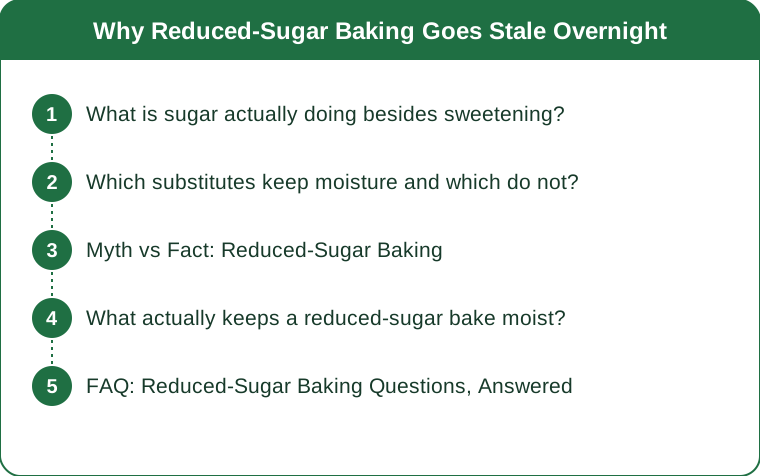
What is sugar actually doing besides sweetening?
Four jobs, and only one of them is taste.
It binds water. Sugar is hygroscopic - it attracts and holds water molecules. In a batter, sugar competes with the flour proteins and starches for available water, and in the finished product it keeps water bound in the crumb rather than letting it migrate to the surface and evaporate. This is the main reason a high-sugar cake stays moist for days.
It slows staling. Staling is not simply drying out. It is largely starch retrogradation - starch molecules that gelatinized and swelled during baking gradually recrystallizing into a more ordered, firmer structure as the product cools and sits. Sugar interferes with this process, so a well-sugared cake firms up more slowly. Reduce the sugar and retrogradation proceeds faster, which is why the change is so noticeable overnight.
It tenderizes. Sugar competes for water with the flour proteins, limiting gluten development. Less sugar means more gluten forms, which produces a tougher, chewier crumb from the same flour and mixing.
It affects browning and structure. Sugar participates in caramelization and Maillard browning, which is why reduced-sugar bakes look pale. It also raises the temperature at which egg proteins set, which affects how the crumb structure forms.
So cutting sugar changes moisture, shelf life, texture, color, and structure - all at once. That is why a straightforward reduction so often produces something that tastes acceptable and behaves badly.
The useful reframe: you are not removing sweetness from a recipe. You are removing a functional ingredient, and you need to replace the functions you still want.
Which substitutes keep moisture and which do not?
This is where most reduced-sugar baking goes wrong, because the substitutes are chosen for sweetness and evaluated on taste.
Substitutes that retain moisture reasonably well:
- Honey, maple syrup, and agave. These are liquid sugars and genuinely hygroscopic - honey in particular is excellent at holding water, and honey-sweetened bakes often stay moist longer than sugar-sweetened ones. They are not lower in sugar, so they solve texture rather than sugar content. Reduce other liquid in the recipe to compensate.
- Fruit purees - applesauce, mashed banana, date paste. These add water, fiber, and some sugar, and the fiber holds moisture. They also add flavor and can make the product denser.
- Allulose. Behaves more like sugar than most alternative sweeteners - it browns, it holds some moisture, and it does not crystallize the way erythritol does. It is the closest functional match among the low-calorie options.
Substitutes that make dryness worse:
- Erythritol and most sugar alcohols. They provide sweetness and bulk but are not hygroscopic in the same way, and erythritol has a tendency to recrystallize, which produces a gritty texture and a distinctly dry mouthfeel. It also gives a cooling sensation many people notice.
- Stevia and monk fruit extracts. These are intensely sweet in tiny quantities, so they replace the sweetness of a cup of sugar with a fraction of a teaspoon of powder. That means you have removed the entire bulk of the sugar, not just its sweetness - all the water-binding, all the tenderizing, all the structure. Pure extract swaps are the single most common cause of dry, tough reduced-sugar baking.
- Simply using less sugar with no replacement. Honest and effective for reducing sugar, and it will produce a drier, tougher, paler result unless you compensate elsewhere.
The rule that follows: if your substitute has no bulk, you must replace the bulk separately - with fruit puree, yogurt, extra fat, or a bulking agent. Swapping sweetness alone leaves a hole in the recipe.

Myth vs Fact: Reduced-Sugar Baking
Myth: Stale means dried out. Fact: Staling is mostly starch recrystallizing, which is a structural change rather than water loss. Proof: bread stored in the fridge goes stale faster than bread on the counter despite losing less water, because refrigeration temperatures accelerate retrogradation. This is why the fridge is the worst place for most baked goods.
Myth: You can reduce sugar by a third in any recipe with no consequences. Fact: Some recipes tolerate it well - dense, fat-rich, fruit-heavy bakes have other sources of moisture and structure. Light sponges, meringues, and anything relying on sugar for structure do not. Tolerance depends on how much of the recipe’s function was sugar-dependent.
Myth: Adding more liquid fixes dryness. Fact: It usually makes things worse. Free water in a batter is not the same as bound water in a crumb - extra liquid evaporates during baking or produces a gummy texture, and it does nothing about retrogradation. What you need is something that holds water, not more water.
Myth: Wrapping it tightly while warm keeps it moist. Fact: Partly true and risky. Wrapping while still warm traps steam, which does keep the crumb moist - and it also creates condensation on the surface, which makes the top soggy and can encourage mold. Cool until just barely warm, then wrap.
Myth: Reduced-sugar bakes need to be eaten the same day. Fact: They need to be stored differently, not eaten faster. Airtight storage at room temperature, a slice of bread in the container to donate moisture, or freezing in portions all extend usable life considerably. Freezing in particular halts retrogradation, and a frozen-then-reheated slice is remarkably close to fresh.
What actually keeps a reduced-sugar bake moist?
Five adjustments, which work together rather than individually.
1. Add a different humectant. Since you removed sugar’s water-binding, put some back another way. Options that work: a couple of tablespoons of honey or maple syrup even in an otherwise reduced-sugar recipe, a portion of the flour replaced by ground almonds, or a few tablespoons of applesauce or Greek yogurt. Glycerin is used commercially for exactly this and works at home in small amounts.
2. Increase the fat slightly. Fat coats flour particles, limits gluten development, and gives a perception of moistness that partially substitutes for sugar’s tenderizing effect. Adding a couple of tablespoons of oil - which stays liquid at room temperature, unlike butter - noticeably improves day-two texture. Oil-based cakes stay softer than butter-based ones for exactly this reason.
3. Do not overbake, and this matters far more than usual. Reduced-sugar batters brown less, so the visual cue you rely on arrives late - which means people routinely leave them in until they look right and by then they are overbaked. Use a skewer and start checking several minutes early. This is probably the most common single cause of dry reduced-sugar baking.
4. Lower the temperature slightly and bake a little longer. A slightly cooler oven produces a more even bake with less moisture loss from the edges, which matters more when there is less sugar holding water in.
5. Store it correctly. Airtight at room temperature, never the fridge. If it will not be eaten within a day or two, slice and freeze it - freezing effectively stops retrogradation, and a thawed slice is far better than a two-day-old refrigerated one. A short warming in a low oven or a few seconds in a microwave temporarily reverses staling by re-melting the recrystallized starch, which is why day-old cake improves so much when warmed.
That last point is genuinely useful and underused: staling is partially reversible with heat. A reduced-sugar muffin that has gone firm overnight is close to fresh after twenty seconds of warming.
FAQ: Reduced-Sugar Baking Questions, Answered
How much can I cut before it fails?
In most standard cakes and muffins, around a quarter is usually tolerable with no other change. A third is manageable if you add a humectant and a little extra fat. Beyond half, the recipe needs redesigning rather than adjusting. Cookies and anything relying on sugar for spread or crispness tolerate much less.
Why does my reduced-sugar cake sink in the middle?
Sugar contributes to structure by controlling how quickly egg proteins set, and cutting it can leave a batter that rises fast and lacks the structure to hold. Underbaking makes it worse, and reduced-sugar bakes are easy to underbake because they look pale. Check with a skewer rather than by color, and avoid opening the oven early.
Does the fridge ever help?
Only for products where food safety requires it - anything with fresh cream, cream cheese frosting, or custard. For those, refrigerate and accept the texture cost, then bring to room temperature before serving. For everything else, room temperature or the freezer.
Will using wholemeal flour make it drier too?
Yes, and the two changes compound. Wholemeal flour absorbs more water than white and its bran fragments interfere with gluten structure, producing a drier, denser crumb. If you are reducing sugar and switching to wholemeal at once, expect to add liquid and fat, or make one change at a time so you can tell which one caused what.
TL;DR:
- Sugar binds water and slows starch retrogradation - cut it and the crumb both dries and firms faster.
- Staling is mostly starch recrystallizing, not water loss, which is why the fridge makes it worse rather than better.
- Intense sweeteners like stevia and monk fruit remove the bulk as well as the sweetness, which is the main cause of dry, tough results.
- Add a humectant, add a couple of tablespoons of oil, lower the temperature slightly, and check with a skewer rather than by color.
- Store airtight at room temperature or freeze in slices; warming a stale slice partially reverses retrogradation.
If your reduced-sugar bake is dry, check whether you overbaked it before changing the recipe. Pale is not underdone.
Keep Reading
This article is for general informational purposes only and is not medical advice. Always consult a qualified health professional for guidance specific to you.