Why Your Healthy Cookies Spread Into One Giant Flat Sheet
Quick Answer: Cookies spread too thin when a healthy swap reduces the fat or sugar that normally helps dough hold its shape, or when the dough isn’t chilled enough before baking. Chilling dough longer and slightly reducing added liquid usually fixes the spread without giving up the healthier ingredients.
You swap butter for a lighter alternative, follow the recipe exactly, and pull out a tray of what looks like one continuous cookie sheet instead of individual cookies.

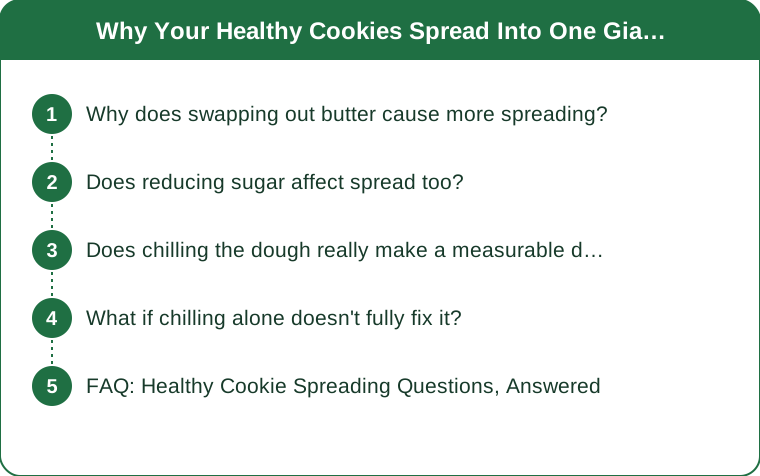
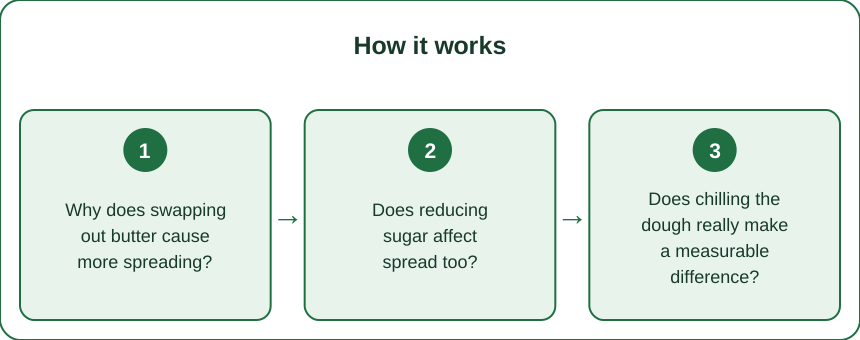
Why does swapping out butter cause more spreading?
Butter has a higher melting point than many lighter fat substitutes like oil or applesauce, so it holds solid longer in the oven before the dough starts to spread. A lower-melting-point fat spreads dough faster and further before the structure has time to set, which is the single biggest cause of over-spread healthy cookies.
Does reducing sugar affect spread too?
Sugar (especially granulated) contributes to spread by melting and thinning the dough as it bakes, so reduced-sugar recipes sometimes actually spread less — but if a recipe swaps to a liquid sweetener like honey or maple syrup, that added liquid can increase spread instead. The form of sweetener matters more than the amount in many cases.

Does chilling the dough really make a measurable difference?
Yes, significantly — chilling solidifies fat back down and lets flour fully hydrate, both of which slow how fast dough spreads once it hits oven heat. A minimum of 30 minutes, and up to overnight, meaningfully firms up dough made with softer, lower-melting-point healthy fat swaps.
What if chilling alone doesn’t fully fix it?
Adding an extra tablespoon or two of flour, or slightly reducing any added liquid sweetener, tightens the dough structure further without needing to abandon the healthier ingredient swaps entirely. Testing one modification at a time (chill first, then adjust flour if still needed) avoids overcorrecting into dry, crumbly cookies.
FAQ: Healthy Cookie Spreading Questions, Answered
Does oven temperature affect spreading?
A slightly lower oven temperature gives dough more time to set before fat fully melts, which can reduce spread, though this needs to be balanced against underbaking in the center.
Is parchment paper versus a greased pan a factor?
A well-greased pan can encourage slightly more spread than parchment, since dough has an easier surface to slide across as fat melts underneath it.
Can I fix already-spread cookies after baking?
Once baked, spread cookies can’t be reshaped, but using a round cutter to trim them into cleaner circles right when they come out of the oven, while still soft, salvages the shape somewhat.
TL;DR:
- Lower-melting-point fat swaps cause dough to spread before it sets
- Liquid sweeteners like honey add moisture that increases spread
- Chilling dough 30 minutes to overnight firms structure significantly
- A small flour increase can tighten dough further if chilling isn’t enough
Spreading is a solvable structural issue, not a sign healthy baking swaps can’t work.
Keep Reading
This article is for general informational purposes only and is not medical advice. Always consult a qualified health professional for guidance specific to you.