Why Your Healthy Baking Behaves Differently in Humid Weather
Quick Answer: Flour is hygroscopic — it absorbs moisture from humid air. In high humidity, a cup of flour can hold 1 to 2 tablespoons of extra water, which throws off the ratio in exactly the recipes that are already low-fat or low-sugar and therefore least forgiving. Reduce liquid by 1 to 2 tablespoons per cup of flour, chill dough before baking, and store flour sealed — those three adjustments solve most humid-weather baking failures.
You’ve made these oat muffins twenty times. In February they’re perfect. In August they’re gummy in the middle and flat on top.
Nothing about your technique changed. The flour did.

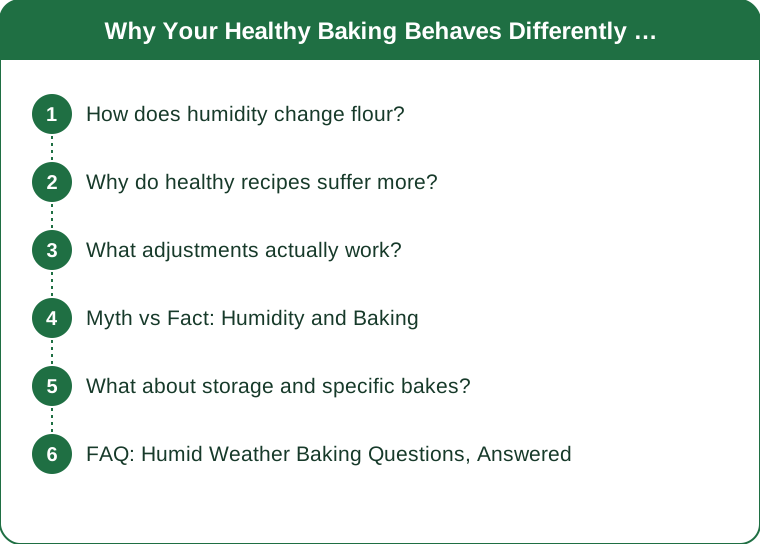
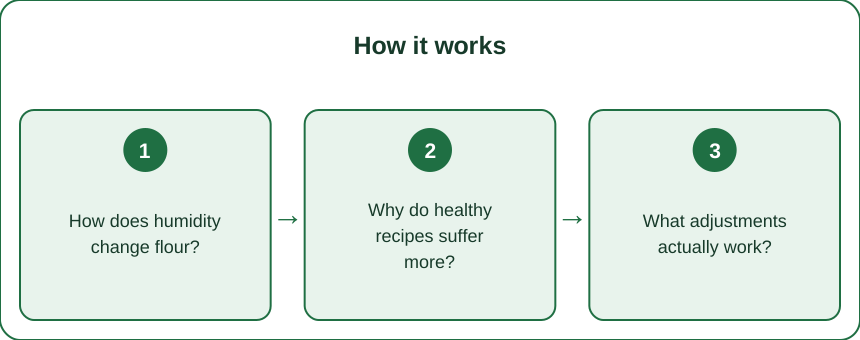
How does humidity change flour?
Flour equilibrates with the air around it, and that means its actual water content varies by season.
Flour typically sits at 11 to 14% moisture and moves within that range depending on ambient humidity. A humid August kitchen pushes it toward the top; a dry heated winter kitchen pulls it toward the bottom.
Three percent doesn’t sound like much until you scale it. A cup of flour is roughly 120g, so a 3% swing is about 3.5g of water — but the effect compounds across three or four cups, and it shifts the hydration ratio the recipe was balanced around.
Measuring by volume makes it worse. Humid flour clumps and packs differently in a measuring cup than dry flour. Two people scooping the same flour in different seasons can differ by 15%.
Whole grain and alternative flours are more hygroscopic than white flour. Oat flour, almond flour, and whole wheat all pull in more moisture, which is why healthier recipes are hit hardest by humidity.
Sugar and salt do it too. Brown sugar hardens or softens with the season, and both affect texture.
Why do healthy recipes suffer more?
Because fat and sugar are the two ingredients that buffer moisture variation, and healthy baking reduces both.
Fat coats flour particles and limits water absorption. In a butter-rich recipe, a little extra moisture in the flour barely registers. In a recipe using applesauce or yogurt in place of butter, there’s nothing standing between the flour and the water.
Sugar binds water — it’s hygroscopic itself. Reducing sugar by a third removes a substantial part of the recipe’s moisture management system. This is why reduced-sugar cookies both spread badly and go stale faster.
Protein powder is the most humidity-sensitive addition of all. It absorbs enormous amounts of water and continues absorbing after baking, which is why a protein muffin that’s perfect warm is dry two hours later — and worse in humid conditions where the batter started wetter than intended.
Alternative sweeteners don’t hold water the way sugar does. Erythritol and allulose behave completely differently, and stevia contributes essentially nothing structurally.
The practical consequence: the more substitutions a recipe uses, the more seasonally variable it is. A recipe that’s foolproof in a test kitchen in November can be genuinely difficult in a humid August.
What adjustments actually work?
Weigh, reduce liquid, chill, and bake slightly longer. In that order of importance.
Weigh your flour. This is the single highest-return change. A kitchen scale removes packing variability entirely. 120g per cup for all-purpose is the standard, and once you’re weighing, the humidity effect shrinks to the actual moisture content rather than the moisture plus the scooping error.
Reduce liquid by 1 to 2 tablespoons per cup of flour in genuinely humid conditions — above about 70% relative humidity. Start with the smaller adjustment. You can add liquid to a stiff batter; you can’t remove it from a loose one.
Chill the dough. 30 minutes in the refrigerator for cookie dough, 20 for muffin batter. Cold fat spreads less and cold batter sets faster at the edges, which counteracts the spreading that excess moisture causes.
Add 3 to 5 minutes of bake time and check with a skewer, not the clock. Extra moisture takes extra time to drive off, and underbaking is what creates the gummy center.
Consider dropping the oven 15°F and extending the time for muffins and quick breads. A slower bake gives moisture time to leave without over-browning the outside.

Myth vs Fact: Humidity and Baking
Myth: Humidity only matters for meringues and macarons. Fact: It’s most dramatic there, because sugar-based foams pull water directly from air. But every flour-based bake is affected, and low-fat recipes are affected more than most people realize.
Myth: You can just add more flour to compensate. Fact: Adding flour changes the ratio of everything else too — leavening, salt, and fat are all now proportionally lower. Reducing liquid is a cleaner correction than adding dry ingredients.
Myth: Airtight storage stops the problem. Fact: It largely does, and it’s the best preventive step — but flour absorbs moisture during the time it’s open on the counter too. A sealed container plus not leaving the bag open while you work is the complete version.
Myth: Air conditioning fixes it. Fact: It helps considerably, because AC dehumidifies as it cools. A kitchen at 72°F with AC is far drier than one at 72°F without it. If you bake in an AC’d kitchen, the seasonal effect is much smaller.
Myth: Old flour is drier flour. Fact: Old flour has equilibrated with whatever it’s been stored in, and it can be wetter or drier. What old flour reliably is, is rancid — whole grain flours go off within three months at room temperature, and that off flavor gets blamed on the recipe.
What about storage and specific bakes?
Storage is prevention, and it costs nothing.
Airtight containers, not the paper bag. Paper breathes, which is exactly the property you don’t want. Any sealed container with a gasket works.
Whole grain and nut flours belong in the freezer, which handles both moisture and rancidity. They can be used straight from frozen for most recipes.
Brown sugar in a sealed container with a terracotta disc or a slice of bread stays soft. Hardened brown sugar measures differently and creams differently.
Cookies: chill, and bake from cold. A humid-weather cookie dough that goes into the oven at room temperature spreads badly. Scooped and chilled for 30 minutes solves it in nearly every case.
Muffins and quick breads: reduce liquid slightly and don’t overfill. Excess moisture plus an overfull cup produces the sunken center that people blame on leavening.
Anything with oats: let the batter rest 10 minutes before baking so the oats absorb before the oven does. This is the fix for gummy oat muffins and it works year-round.
Crisp things go soft fast in humid weather regardless of what you do. Store granola, biscotti, and crackers with a silica packet or re-crisp for 5 minutes at 300°F before serving.
FAQ: Humid Weather Baking Questions, Answered
How do I know if my kitchen is humid enough to matter?
A cheap hygrometer settles it. Above 60% relative humidity, start adjusting; above 70%, adjust every time. Below 50%, you may actually need slightly more liquid rather than less.
Should I dry my flour in the oven?
Some bakers do — 15 minutes at 200°F, cooled fully before use. It works, but it’s more effort than reducing liquid by a tablespoon and it risks starting to cook the starch if you overshoot.
Why do my cookies spread more in summer even with chilled dough?
Warm kitchen air, warm baking sheets, and the humid flour together. Use a cool sheet for every batch — putting dough on a sheet that just came out of the oven is the most common cause of unexplained spreading.
Does this affect no-bake recipes too?
Yes, particularly anything set with oats, dates, or protein powder. Humid conditions make no-bake bars softer and stickier — a stint in the freezer rather than the fridge usually fixes the set.
Is the effect bigger with gluten-free flours?
Generally yes. Rice flour, tapioca starch, and blends vary considerably in absorption and are more sensitive to hydration changes, which is why gluten-free recipes tend to specify weights rather than cups.
TL;DR: Humidity is an unlisted ingredient, and healthy recipes have the least tolerance for it.
- Flour absorbs 1 to 2 tablespoons of extra water per cup in humid air, and whole grain flours absorb more.
- Low-fat and low-sugar recipes suffer most, because fat and sugar are what normally buffer moisture variation.
- Weigh your flour — 120g per cup — which eliminates the larger scooping error before you touch the humidity one.
- Reduce liquid by 1 to 2 tablespoons per cup, starting conservative.
- Chill the dough and bake on cool sheets. Most summer spreading is a temperature problem stacked on a moisture one.
- Store flour airtight, whole grain flours in the freezer, and let oat batters rest 10 minutes.
Buy a scale before you buy anything else. It solves more baking inconsistency than any technique, and it costs less than one failed batch of ingredients.
Keep Reading
This article is for general informational purposes only and is not medical advice. Always consult a qualified health professional for guidance specific to you.