Why Your Healthy Baking Recipes Keep Turning Out Dense or Dry
Quick Answer: Dense or dry healthy-baked goods almost always come down to swapping too many ingredients at once — replacing butter, sugar, and flour all in one recipe disrupts the structure and moisture balance that each ingredient was individually responsible for.
Healthy baking swaps get blamed on the ingredients themselves, when the real issue is usually doing too many substitutions in a single recipe without adjusting for how they interact.

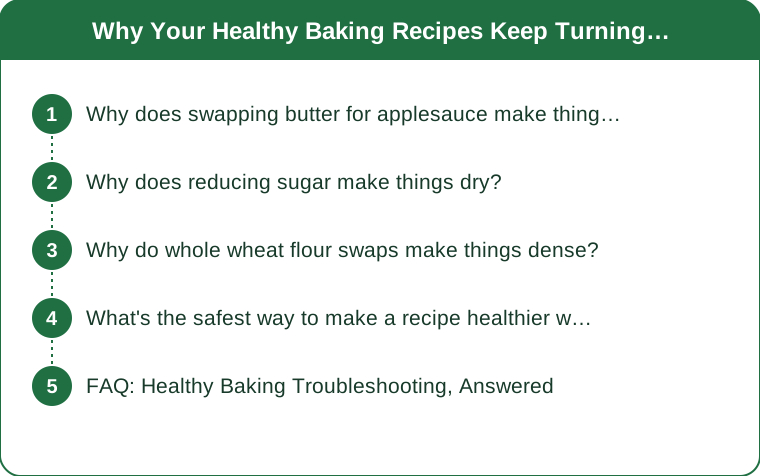
Why does swapping butter for applesauce make things dense?
Butter does more than add fat — it creates air pockets during creaming that give baked goods structure and lift. Applesauce adds moisture but none of that aeration, so recipes swapping butter entirely often need an extra leavening boost (a bit more baking powder) to compensate.
Why does reducing sugar make things dry?
Sugar isn’t just sweetness — it holds moisture and slows gluten development, both of which affect texture. Cutting sugar significantly without adding another moisture source (like an extra egg or a splash of milk) often results in a drier, tougher bake.

Why do whole wheat flour swaps make things dense?
Whole wheat flour absorbs more liquid than white flour due to its higher fiber content, so a direct 1:1 swap without adding extra liquid leaves the batter drier than the recipe was designed for, resulting in dense texture.
What’s the safest way to make a recipe healthier without ruining it?
Change one variable at a time and test it, rather than swapping sugar, flour, and fat all in the same attempt. Starting with a 50% swap (half whole wheat flour, half white, for example) is a safer entry point than a full substitution.
FAQ: Healthy Baking Troubleshooting, Answered
Can Greek yogurt replace oil in baking?
Often yes, especially in muffins and quick breads, though it can add slight density — pairing it with a touch of extra baking powder helps offset that.
Why do healthy baked goods sometimes sink in the middle?
This usually means too much leavening was added to compensate for a swap, or the oven temperature was too low, causing the structure to set before the center fully cooks.
Is it worth using a scale instead of measuring cups for healthy baking?
Yes, more so than in standard baking — since substituted ingredients often have different densities than what a recipe was designed around, weighing ingredients reduces one more variable that can throw off the final texture.
TL;DR:
- Multiple simultaneous swaps, not any single ingredient, usually cause dense or dry results
- Butter swaps need extra leavening to replace lost aeration
- Sugar reductions need an added moisture source to avoid dryness
- Change one variable at a time and test before committing to a full swap
Next time a healthy recipe disappoints, try reverting just one swap back to the original ingredient and see if that alone fixes the texture.
Keep Reading
This article is for general informational purposes only and is not medical advice. Always consult a qualified health professional for guidance specific to you.